

By 2026, AI search has become as familiar to users as typing a query into a browser bar. Instead of scrolling through ten blue links, people now ask a question and receive a synthesized answer from an AI powered search engine. Systems like ChatGPT, Google’s AI Overviews and AI Mode, Perplexity, Microsoft Copilot, and Gemini have turned search into a conversation rather than a list of results.
AI Search in 2026: What It Is and How It Works
The core difference between traditional search and AI powered search lies in how the answer is built. Traditional search engines rank pages and let the user pick the most relevant one. An AI search engine reads multiple sources, extracts the most useful pieces of information, and generates a single, ready answer – often with citations, sometimes without.
This shift matters for anyone producing content in 2026. It’s a mistake to optimize content for Google alone. AI in Google Search already pulls from a far wider pool of sources than a classic search index: forums, review platforms, video content, and social media all feed into what an AI system treats as “an answer.” YouTube video descriptions, Instagram captions, TikTok transcripts, Reddit threads, and product reviews can all become part of an AI generated answers result – meaning brands now need a presence far beyond their own website.
How AI SEO Differs from Traditional SEO
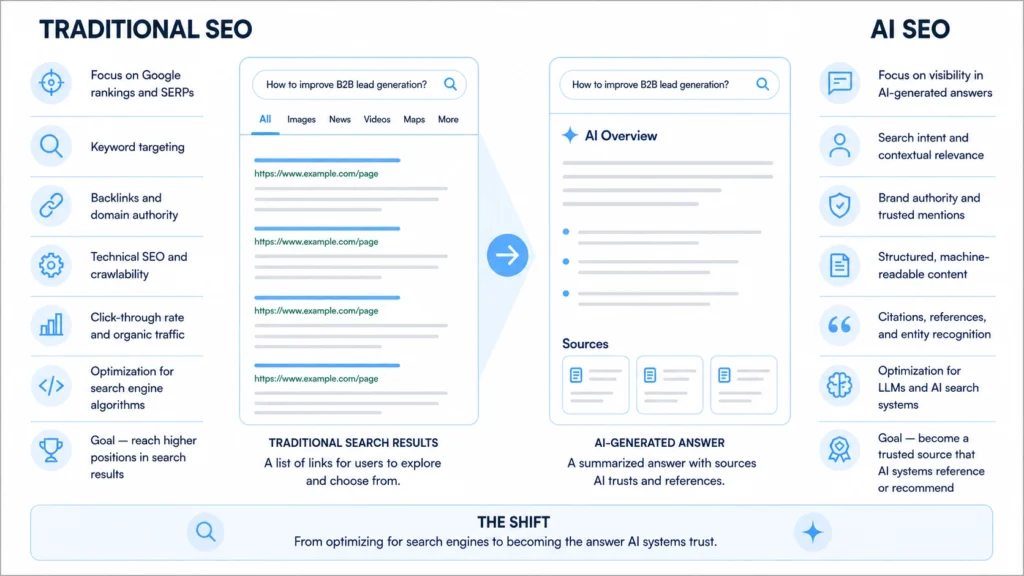
AI SEO, or AI search engine optimization, is not the same discipline as classic ranking work, even though the two share a lot of DNA. Traditional SEO optimizes for an algorithm that returns a list of pages. Generative Engine Optimization – another name increasingly used for the same practice – optimizes for a language model that reads, interprets, and synthesizes content before a user ever sees a link.
This means the goals shift slightly. A page can rank on page one for a keyword and still never get picked up by AI Google Search if the model doesn’t consider it authoritative, clear, or citable enough. Conversely, a smaller site with precise, well-structured content can be quoted in an AI-generated answer even without a top organic position.
That said, AI SEO does not replace traditional SEO – it builds on top of it. Quality content, E-E-A-T, backlinks, technical optimization, internal linking, and a clear site structure remain just as important for AI-driven results as they are for classic rankings. Google itself has confirmed that fundamental SEO practices continue to matter for AI Overviews and AI Mode. In practice, an AI SEO strategy should be treated as an additional layer of optimization built on top of Traditional SEO, not a separate discipline replacing it.
AI Search Optimization: Core Principles and Practical Strategies
Optimize Content Around AI-Generated Sub-Queries
AI models rarely process a query the way a search engine does. Instead, they break a broad question into smaller sub-questions before assembling an answer. If the main query is “How to choose a CRM for a small business?”, an AI system might internally generate sub-queries such as “best CRM features for small teams,” “free vs paid CRM tools,” and “how much does CRM software cost.” Content that directly answers these narrower questions – ideally within the same article – has a much better chance of being pulled into the final response. Optimize content for AI search by mapping out the sub-questions behind your main topic and giving each one a clear, dedicated answer.
Focus on Content Quality and Original Value
No structural trick compensates for weak content. AI models are built to recognize genuinely useful material – original research, real examples, first-hand expertise, and practical takeaways rather than generic filler. SEO for AI search starts with the same question that has always mattered: does this content say something worth reading? An article that simply repeats what ten other pages already say has little chance of being cited, no matter how well it’s formatted.
Make Content Easy for AI to Understand and Cite
Clear headings, short paragraphs, bullet lists, tables, definitions, and direct answers all help AI systems parse content faster and cite it more confidently. A model looking for a quick, accurate answer favors text that states facts plainly rather than burying them in long narrative paragraphs. Adding a well-structured FAQ section is one of the simplest ways to increase the odds of an AI citation, since FAQ-style Q&A blocks map almost directly onto how AI systems phrase their own answers.
Keep Content Fresh and Up to Date
AI systems favor recency, especially for topics tied to prices, statistics, tools, or regulations. Outdated numbers or discontinued products quickly lower a page’s usefulness in the eyes of a model built to give current answers. Reviewing and updating key articles on a regular schedule – not just publishing once and forgetting about them – is part of any serious AI SEO best practices routine.
Strengthen E-E-A-T and Trust Signals
Experience, expertise, authority, and trust remain central to how both traditional and AI-driven systems evaluate content. Author bios, credentials, transparent sourcing, and real case studies all reinforce these signals. Businesses can track how these signals are perceived through Google Search Console, Google Business Profile reviews, Trustpilot, and industry-specific directories, all of which feed into the broader trust picture an AI model builds around a brand.
Increase Brand Mentions Across Digital Channels
Brand mentions across the web act as votes of confidence that AI systems weigh heavily. A brand referenced on relevant websites, in media coverage, on forums, in social media discussions, and on industry platforms builds the kind of digital footprint that generative models recognize as credible. Forums deserve particular attention: AI search tools draw especially heavily on Reddit and Quora threads, where real user opinions and comparisons carry significant weight. The goal isn’t mentions everywhere – it’s mentions on resources that are genuinely relevant and authoritative within your niche, since low-quality or irrelevant sources add little to AI brand visibility.
Maintain Strong Technical SEO
A technically sound site remains the foundation everything else is built on. Fast load times, mobile-friendly design, clean crawlability, structured data, and a logical site architecture all help both search engines and AI crawlers access and interpret content correctly. Teams that optimize website for AI search as part of a broader AI SEO for website approach should improve Technical SEO as a prerequisite, not an afterthought – no amount of great content compensates for a site that AI crawlers can’t properly index.
Measure and Improve AI Search Visibility
AI search visibility can now be tracked through a growing set of platforms: Google Search Console for AI Overviews performance, dedicated AI-tracking dashboards, and the leading competitor analysis software for AI search optimization on the market, which lets brands see how often they – and their competitors – appear in AI-generated answers.
Three metrics matter most. Share of Voice measures how often a brand appears in AI-generated answers compared to competitors within the same topic or niche – and it’s most useful when compared directly against a competitor’s numbers rather than viewed in isolation; that’s essentially how to calculate share of voice in practical terms. Source citations track how often a brand’s content is directly referenced or linked within an AI answer. Referral traffic from AI shows how many real visitors land on a site after clicking through from an AI-generated response. To make sense of these numbers, a business needs to analyze web behavior and set clear benchmarks upfront – without a starting point, it’s impossible to tell whether AI search ranking and visibility are actually improving over time. An AI search algorithms summary published by major SEO platforms each year is also worth reviewing, since ranking signals for classic and AI-driven results overlap far more than they diverge.
Key Takeaways for AI Search Optimization
Optimizing for AI search in 2026 isn’t about chasing a new algorithm – it’s about extending proven SEO fundamentals into a new format of answer. A few principles stand out:
- AI mode google search and other AI systems reward clear, well-structured, genuinely useful content over keyword-stuffed pages.
- Structuring content around real sub-queries, using FAQs, and keeping information current all improve the chances of appearing in AI search results.
- Brand mention tracking across forums, media, and social platforms builds the trust signals AI systems rely on.
- Technical SEO and E-E-A-T remain the backbone of visibility, whether the result comes from a ranked list or a generated answer.
- Measuring Share of Voice, citations, and referral traffic – and comparing them against benchmarks – is the only way to know if an AI SEO optimization effort is working.
Getting AI search SEO right in 2026 means building on decades of classic optimization, not discarding it. Businesses that treat AI SEO optimization tools and classic SEO as complementary, not competing, strategies are the ones most likely to figure out how to appear in AI search results consistently. Pairing strong technical and content foundations with a broader content marketing approach – and combining it with a wider AI-driven brand marketing strategy – gives brands the best shot at staying visible as AI search engine optimization continues to evolve.
Ultimately, brands that use content marketing to consistently produce clear, well-structured, and citable content will be the ones that stay visible in AI search well beyond 2026.